
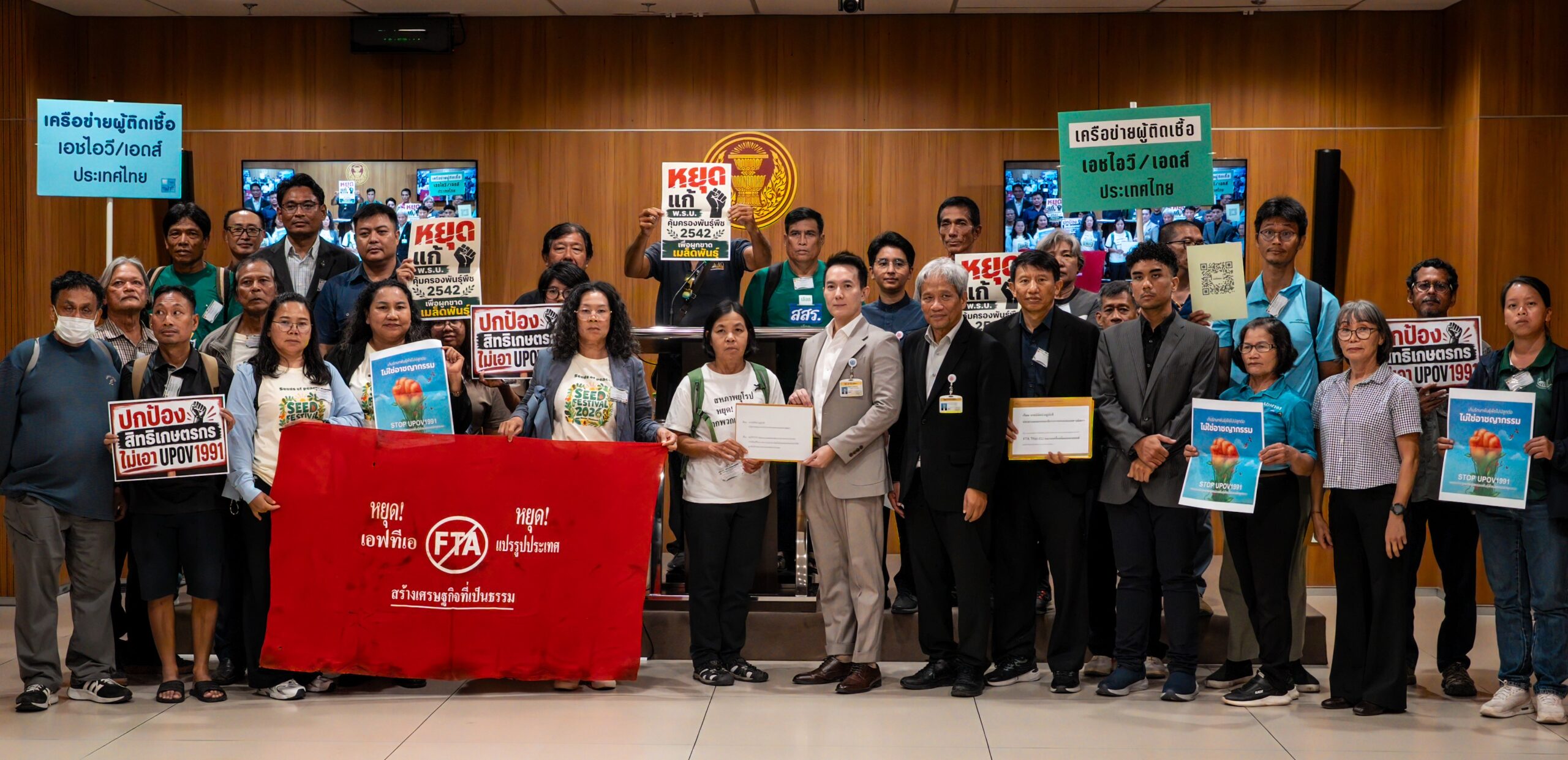
Bangkok, 17 September 2026 – One hundred and forty-six people’s organisations and non-governmental organisations have jointly submitted an open letter to political leaders and to Parliament, calling on them to monitor, scrutinise and press the government and the Thai negotiating team on the Thailand–European Union Free Trade Agreement (Thailand–EU FTA) to place the public interest and the rights of the people first. The call comes ahead of the tenth round of negotiations, scheduled for 28 September to 6 October 2026 in Phuket — a critical juncture that could lead to the conclusion of the talks.
Civil society groups warned that although the two sides have already concluded 15 of the 24 chapters, a number of important and sensitive issues remain on the negotiating table. These could have long-term consequences for Thailand’s economy, society, public health, agriculture, the rights of its citizens, and the country’s policy space. The negotiations should therefore not be rushed to a close through cross-sectoral trade-offs — that is, by bargaining away farmers’ rights, access to medicines, health, the environment or consumer protection in exchange for commercial gains in other sectors.
“UPOV 1991” a Critical Red Line: Threat to Farmers’ Rights and Food Sovereignty
The single most important demand from civil society is that Thailand must not accept any commitment to accede to the UPOV 1991 Convention, must not amend domestic law to conform with that Convention, and must not accept any alternative wording that would, in practice, deliver an equivalent outcome to UPOV 1991 compliance.
Civil society organisations point out that Thailand already has the Plant Variety Protection Act B.E. 2542 (1999), which was designed to strike a balance between protecting plant breeders on the one hand and the rights of farmers and communities, local plant varieties, and benefit-sharing from genetic resources on the other. Requiring Thailand to become a party to UPOV 1991, or to bring its law into line with the Convention, is an obligation that goes beyond what is required under World Trade Organization commitments and would erode the country’s policy space.
UPOV 1991 broadens the scope and extends the duration of plant breeders’ rights, while restricting the right of farmers to save seed from their harvest for replanting. A study previously presented by civil society to the Thai negotiating team found that compliance with UPOV 1991 could raise Thai farmers’ seed costs by two to six times over the long term, with knock-on effects on food prices.
Nantawan Handee, a leading figure in the Alternative Agriculture Network, further warned that the impacts are not confined to seed prices. They extend to the very practices by which farmers save, select, exchange and improve their own seed, to biodiversity, to the protection of genetic resources and community knowledge, and ultimately to the country’s food security and food sovereignty.
“I am disappointed by the response from the representative of the Department of Agriculture, who is intent on protecting only the private companies in the seed business while ignoring the livelihoods of small-scale farmers, which will collapse if the Plant Variety Protection Act has to be amended. This is about the food security on everyone’s plate,” added Yupin Kasena.
No to TRIPS-plus: Warnings of Greater Drug Monopolies and Costs of Up to 3.7 Trillion Baht Over 30 Years
Chalermsak Kittikrakul of the Thai Network of People Living with HIV/AIDS affirmed that Thailand must not accept intellectual property measures that go beyond the TRIPS Agreement — so-called “TRIPS-plus” provisions. These include data exclusivity, market exclusivity, patent term extension, and any other measure that would delay the market entry of generic medicines and prolong pharmaceutical monopolies.
A 2025 study conducted jointly by the Food and Drug Administration, the National Health Commission Office and a network of academics found that the European Union’s intellectual property proposals could delay the entry of generic medicines onto the market by at least two years, and in some cases by as much as eleven years. The study estimated that Thailand’s pharmaceutical expenditure could rise by approximately 130 billion baht over 10 years, 770 billion baht over 20 years, and as much as 3.7 trillion baht over 30 years — with consequences for patients, the universal health coverage system, the domestic pharmaceutical industry, and the country’s medicine security.
Concerns Over Alcohol Market Liberalisation and Digital Trade Shrinking Public Policy Space
Teera Watcharapranee, Director of the StopDrink Network Office, urged the government not to rush into reducing or eliminating customs tariffs on alcoholic beverages if doing so would increase access and consumption. He stressed that the state must retain its authority to use tax and pricing measures, to control marketing and advertising, to require warning labels, to restrict the hours and locations of sale, and to apply other public health measures. According to the figures cited in the open letter, the economic cost of alcohol consumption in Thailand in 2021 amounted to approximately 165,450.5 million baht, or 1.02 per cent of GDP.
“The state collects more than 1,200 million baht in excise tax from community liquor producers alone, which reflects how deeply this sector is linked to the local economy, to farmers and to local labour. This is a genuinely community-level economy. If alcoholic beverages are liberalised, we will not be able to compete; it will destroy small operators, community enterprises and more than 1,800 small and micro producers nationwide. If at all possible, we ask that any tariff reduction be phased in gradually over 10 to 15 years so that we have time to adapt, as Vietnam has done,” Theerawut Klomlaew of the Phrae Siam Craft Spirit Club concluded.
On digital trade, Nisara Kaewsuk, an academic with the Thailand Consumers Council, called on Thailand to reject commitments that would restrict the state’s ability to enact or amend laws in the future — whether on personal data protection, cybersecurity, digital taxation, the regulation of artificial intelligence, the safety of goods and services sold on platforms, or consumer protection. She singled out commitments on cross-border data flows and restrictions on measures requiring data to be stored or processed domestically.
Thailand Must Not Become a Dumping Ground for Hazardous Chemicals, Used Goods and Foreign Waste
Another area in which civil society is demanding that the government explicitly preserve its policy space concerns the control of agricultural chemicals, used and remanufactured products, plastic waste, electronic waste, and materials that may be contaminated with hazardous substances. Thailand must not accept commitments that would make it easier to import such goods and materials, or that would limit its authority to set standards, inspect, license or prohibit their import.
At the same time, civil society called on Thailand to press the European Union to halt the export to Thailand of pesticides and hazardous agricultural substances that are banned, withdrawn or not approved for use within the EU itself on grounds of harm to health or the environment. Shifting such risks onto farmers and consumers in trading-partner countries, they argue, contradicts the EU’s own stated goals on sustainable food systems, Prokchol Ousap, Director of the BioThai Foundation, emphasised in closing.
Parliament Called On to Scrutinise Before the Talks Are Concluded
The 146 organisations called on political leaders and the relevant parliamentary committees to monitor the positions taken by the government and the negotiating team both before and after the tenth round, and to summon the responsible agencies to report on the outcome of the negotiations — including which proposals Thailand has accepted and which it has not. Of particular concern are UPOV 1991, intellectual property and access to medicines, digital trade, alcoholic beverages, agricultural chemicals, used and remanufactured goods, plastic waste and electronic waste.
They further demanded that sufficient information on negotiating positions in areas of public impact be disclosed, and that a meaningful consultation process be held with farmers, consumers, patients, academics, civil society organisations and other stakeholders before the government agrees to any major commitment.
Senator Pornchai Wittayalertpanya said at the press conference that parliamentary mechanisms would have to be used to scrutinise the matter urgently, because once the negotiations are concluded at the end of this month and any damage has been done, it will be extremely difficult to revisit or amend the agreement afterwards.

Kannikar Kijtiwatchakul, Deputy Chair of FTA Watch (the People’s Study Group on Free Trade Agreements), speaking on behalf of the 146 civil society organisations, said: “Concluding the agreement quickly should not be a more important objective than securing an agreement that is good and fair for the Thai people. Whatever gains in exports or investment may materialise in the short term should not be traded against farmers’ rights, food security and food sovereignty, access to essential medicines, public health, biodiversity, the environment, consumer protection, or the policy space the Thai government will need in order to meet future challenges.”
Civil society organisations stressed that the decisions taken in these negotiations will bind Thailand and its people for decades to come. The government should therefore not rush to close the talks if it cannot yet secure an agreement that safeguards the interests of the country and its people on these critical issues.