
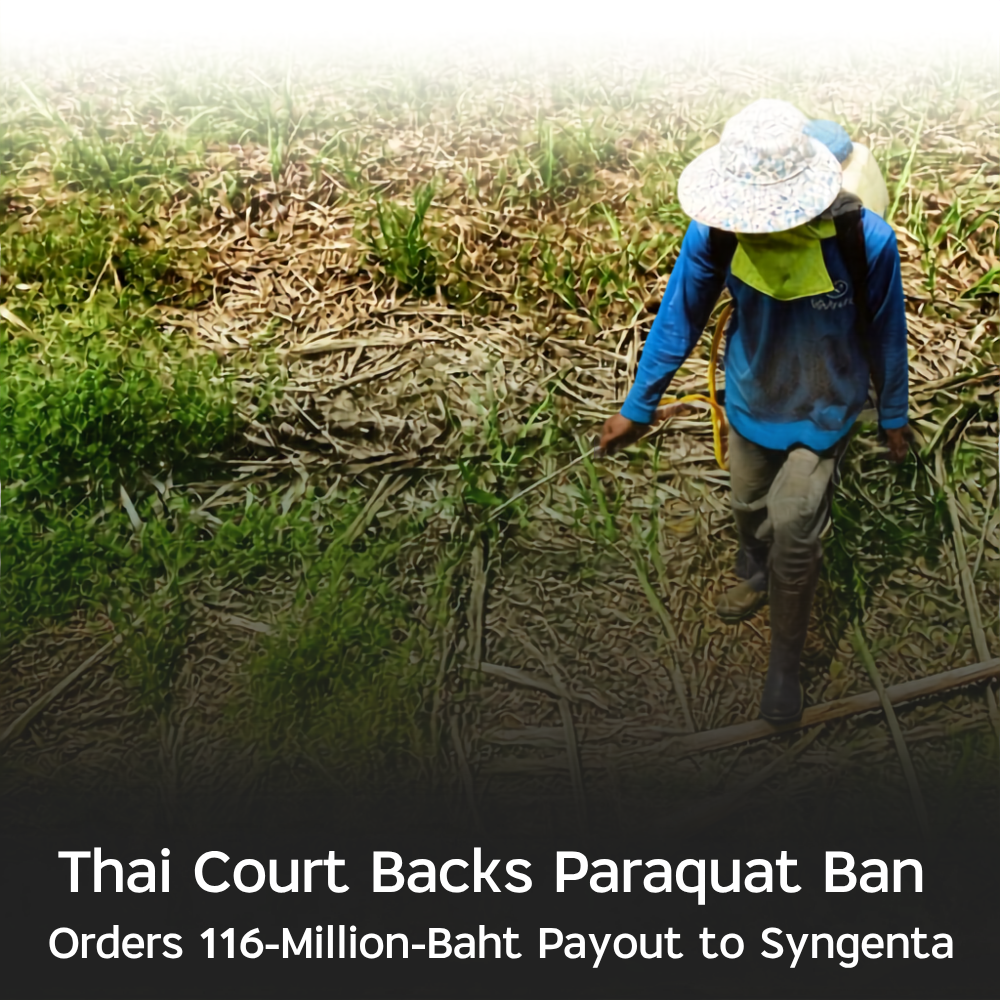
A six-year saga, in which Syngenta sought to overturn Thailand’s ban on the herbicide paraquat and the insecticide chlorpyrifos, has been decided at first instance. The Court upheld the state’s power to impose the ban and found that it had acted lawfully. In a parallel case, however, the same court ordered the Department of Agriculture to pay out more than 116 million baht of public money to compensate the company.
What the case is about
For more than three decades, two agricultural chemicals were used extensively across Thailand.
Paraquat
A herbicide, known by the trade name “Gramoxone”- A non-selective contact herbicide: it destroys any plant tissue it touches. Widely used in sugarcane, maize, rubber, oil palm and cassava.
- There is no antidote. Even limited skin contact through an open wound can prove fatal.
- Associated with Parkinson’s disease — a condition causing tremor, difficulty walking and loss of motor control.
Chlorpyrifos
An organophosphate insecticide- Used against insect pests in maize, sugarcane, legumes, cotton and a range of fruit crops.
- Disrupts the nervous system, causing tremor and convulsions, and can be fatal.
- Impairs foetal brain development, slowing learning, memory and cognition, with effects that may last a lifetime.
In 2019 the Hazardous Substances Committee resolved to withdraw both substances from use, reclassifying them from “Type 3 hazardous substances” (permitted under licence) to “Type 4 hazardous substances” — a category under which production, import, export and possession are prohibited outright.
Syngenta Crop Protection Limited, the principal importer, contested the decision and brought two separate actions before the Administrative Court. The litigation ran for six years.
Timeline of key events
- 23 May 2018 The Hazardous Substances Committee resolves to adopt “restricted use” measures for three substances — paraquat, chlorpyrifos and glyphosate. This falls short of a ban.
- 30 June 2019 The Department of Agriculture ceases to authorise further imports of the two substances.
- 22 October 2019 At its 41-9/2562 meeting, the Hazardous Substances Committee resolves to reclassify all three substances as Type 4 with effect from 1 December 2019, and directs that a draft notification be prepared and put out for public consultation.
- November 2019 A 15-day online public consultation draws 48,789 respondents: 12,143 (24.89 per cent) support the ban; 36,656 (75.11 per cent) oppose it.
- 27 November 2019 The decisive vote. At its 1-1/2562 meeting, the Hazardous Substances Committee resolves that paraquat and chlorpyrifos be designated Type 4 hazardous substances with effect from 1 June 2020. Glyphosate is to remain subject only to restricted-use measures.
- 15 May 2020 The Ministry of Industry issues the Notification on the List of Hazardous Substances (No. 6) B.E. 2563, published in the Royal Gazette on 19 May 2020.
- 25 May 2020 The Director-General of the Department of Agriculture issues Department of Agriculture Order No. 750/2563, setting out the recall procedure. Clause 8 states in terms that “the Department of Agriculture shall bear no expense whatsoever” — the provision that would become the central point of dispute.
- 1 June 2020 The ban takes effect. Farmers must return stock to retailers within 90 days; retailers must return it to manufacturers and importers within 120 days; and manufacturers and importers must submit a disposal plan within 270 days (by 25 February 2021).
- 18 August – 1 September 2020 The Foundation for Consumers and the BioThai Foundation apply to join the proceedings as interveners, and the Court grants leave — a welcome precedent in Thai environmental litigation, allowing civil society organisations to place evidence directly before the Court.
- 15 February – 4 March 2021 The company files its disposal plan and Department of Agriculture officials certify the quantities held. In total, 1,169,840 litres of paraquat are consigned for incineration at Akkhie Prakarn Public Company Limited.
- 7 July 2026 The Central Administrative Court holds its first hearing in the compensation case.
- 31 July 2026 The Central Administrative Court delivers judgment in both cases on the same day.
Case 1 — The Court upholds the ban as lawful
The company asked the Court to revoke the prohibition notification. The Court held that the state had acted properly, and the ban on these severely hazardous chemicals therefore remains in force.
1The notification was issued through a proper procedure
The company argued that because a clear majority of consultation respondents (75 per cent) opposed the ban, the state ought not to have proceeded. The Court rejected the argument, holding that a public consultation is “merely an opportunity for the public and relevant sectors to participate by submitting information for the consideration of the responsible agencies. The views of the public and of the various sectors have no binding legal effect … such that a decision must be taken in accordance with the opinion of the majority of respondents.”
2The Court applies the precautionary principle — the most significant element of the judgment
The precautionary principle holds, in essence, that where there is sufficient indication that something is likely to be harmful, the state need not wait for conclusive proof before acting. To wait for complete certainty is to risk allowing irreversible damage to occur in the meantime.
Notably, the principle is not codified in Thai law. The Court nonetheless read it into the statutory scheme by way of the Constitution.
Summarising the substance of the principle, the Court held that the state is under a duty to exercise care to minimise adverse effects on the public, on communities, on the environment and on biological diversity “even where there is not yet scientific data conclusively establishing the cause and degree of the harm that may befall the public, animals, plants, property or the environment.”
The Court further emphasised that Section 18, paragraph two, of the Hazardous Substances Act “is not directed solely at safeguarding human life and physical safety, but is also intended to protect the animals, plants, property and the environment that exist within that environment alongside human beings.”
3Restricted use was not enough; only withdrawal would do
Before the ban, the state had issued a 2019 Ministry of Agriculture and Cooperatives notification restricting the use of paraquat, prohibiting its application in areas under vegetable or medicinal-plant cultivation, in watershed areas, in public spaces, and in sensitive locations such as schools, hospitals and childcare centres.
The Court found those measures insufficient, since they prohibited use only in certain areas.
4The public interest outweighs the loss to private parties
The Court accepted that the ban would inevitably affect manufacturers, importers, retailers and farmers. Weighing the competing interests, however, it concluded that “the benefit to be derived from such action is the greater.” The exercise of discretion by the Minister, with the concurrence of the Hazardous Substances Committee, was accordingly lawful.
The Court also recorded that “illness among the population resulting from exposure to paraquat and chlorpyrifos will affect the national public health system, which must care for and treat those who fall ill … whether directly or indirectly.”
The evidence of harm recorded in the judgment
The judgment sets out the scientific evidence in considerable detail, drawing on the report of the Extraordinary Committee of the House of Representatives on the Study of Approaches to Controlling the Use of Chemicals in the Agricultural Sector. This is the portion of the ruling most likely to be cited in future proceedings.

Paraquat
As recorded in the judgment- A synthesis of 104 studies confirms that exposure to paraquat carries a risk of Parkinson’s disease.
- It crosses the blood–brain barrier and enters dopaminergic cells.
- Mahidol University detected residues in the serum of newborns and mothers in 17–20 per cent of cases.
- Residues were found in the meconium of newborns in 54.7 per cent of cases, from a sample of 53 mothers.
- Pregnant women working in agricultural areas during months six to nine of pregnancy showed residue levels 5.4 times higher than those who did not.
- The Ramathibodi Poison Center recorded 4,223 patients between 2010 and 2016, of whom 1,950 died.
- Naresuan University found paraquat exceeding the Codex standard in every fish sample taken from the Kok River.
- The European Union classifies paraquat as fatal if inhaled; the U.S. EPA places it in Category I for acute inhalation toxicity.
Chlorpyrifos
As recorded in the judgment- Causes neurotoxicity in children exposed in utero, impairing learning, memory and cognition, with effects that may last a lifetime.
- Linked to Parkinson’s disease, to depressive behaviour and to suicide among farmers.
- The Chulabhorn Research Institute found that it promotes the growth of H508 colon cancer cells and is associated with a 2.7-fold increase in rectal cancer risk.
- Naresuan University detected residues in 14 of 21 samples of village tap water in Nan province.
- Residues were detected in the breast milk of post-partum mothers in agricultural provinces (Kanchanaburi, Nakhon Sawan and Amnat Charoen), exceeding the acceptable intake for a two-month-old infant.
- In Thai-PAN testing of 446 vegetable samples, pennywort exceeded the default limit by up to 310 times; holy basil and ivy gourd by 110 times.
- Department of Medical Sciences testing in 2018 found residues in 16.9 per cent of 160 vegetable samples, with 13.8 per cent exceeding the standard.

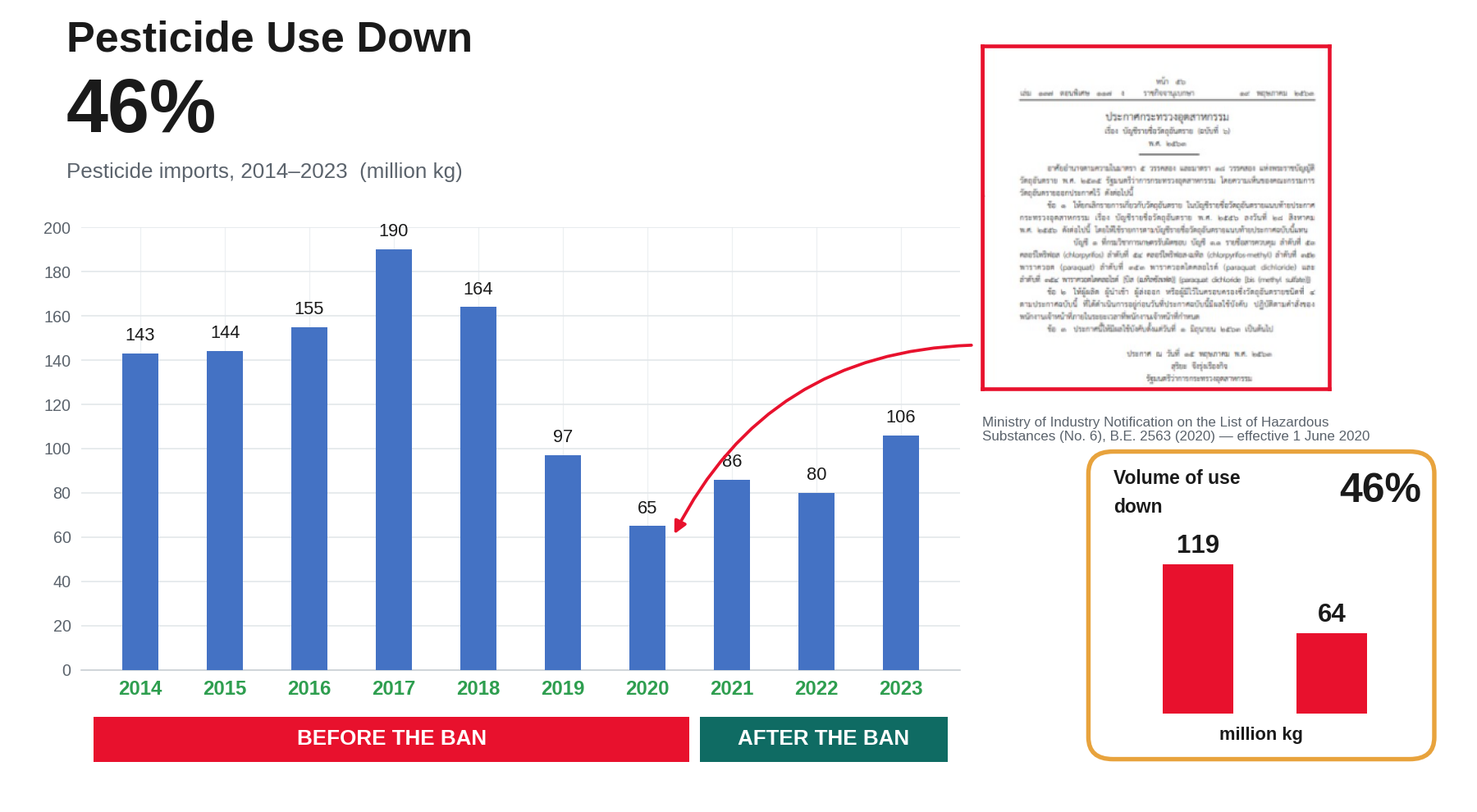
Paraquat: 30,440 tonnes in 2015 · 31,526 tonnes in 2016 · a peak of 44,501 tonnes in 2017 · 22,162 tonnes in 2018 · 9,944 tonnes in the first half of 2019.
Chlorpyrifos: 2,350 tonnes in 2015 · 2,256 tonnes in 2016 · 3,700 tonnes in 2017 · 2,220 tonnes in 2018 · 1,016 tonnes in the first half of 2019.
Case 2 — The Court orders the state to pay 116.98 million baht
The Court held that the ban itself was lawful, but that the state could not require the company to fund the disposal, because the law conferred no such power. Since the company had already paid, the state must reimburse it.
The dispute turned entirely on Clauses 6, 7 and 8 of Department of Agriculture Order No. 750/2563, which required licensed manufacturers and importers to collect stock returned by retailers and farmers nationwide, to store it and to incinerate it, while providing that the Department “shall bear no expense whatsoever.”
The Court’s reasoning: the state had no power to make such an order
Having examined Sections 41, 43 and 52 of the Hazardous Substances Act B.E. 2535 (1992), the Court concluded:
The Court further observed that Section 52, on which the state relied, applies to operators who have contravened the law. This company, by contrast, had operated lawfully throughout, having been incorporated on 26 January 1981. The burden it faced arose not from any wrongdoing but from the state’s decision to eliminate a danger in the public interest. Accordingly, “the plaintiff, having acted in good faith and having been required to bear a burden arising from action taken to preserve the public interest, is entitled to protection by the state. The state may not treat the plaintiff as though it were a person who had contravened the provisions of the law.”
Since the state was well aware that large quantities remained in circulation and that disposal would be costly, yet made no provision for assistance of any kind, the Court held that this imposed an undue burden upon the plaintiff.
How the Court arrived at the figure
consigned by the company for incineration
the Department of Agriculture’s own cost estimate
damages awarded by the Court
Notably, the company had claimed 127,054,070.02 baht, a sum that included transport, storage, packaging and outstanding customer receivables. The Court awarded disposal costs alone, applying the Department of Agriculture’s own estimate on the ground that it constituted “an estimate prepared by state officials directly responsible for the matter, drawn from a database grounded in technical principles and therefore carrying evidential weight.”
Compensation case (Red Case No. Sor. 7/2569): the Department of Agriculture is to pay 116,984,000 baht, together with interest at 3 per cent per annum (or such new rate as may be fixed by Royal Decree) plus an additional 2 per cent per annum, running from the day after the filing of the claim until payment is made in full, subject to a ceiling of 5 per cent per annum. Payment is to be made within 60 days of the judgment becoming final. Part of the court fees is to be refunded to the plaintiff in proportion to its success. The claims against the Ministry of Agriculture and Cooperatives and the Ministry of Finance are dismissed.
Ban case (Red Case No. Sor. 8/2569): Clauses 6, 7 and 8 of Department of Agriculture Order No. 750/2563 are revoked only in so far as they require licensed manufacturers and importers to take back substances from possessors, distributors or retailers for storage and destruction at their own expense — the clauses are not struck down in their entirety. The revocation takes effect retrospectively from the date the Order was issued. The claims against the Ministry of Industry, the Minister of Industry, the Hazardous Substances Committee and the Department of Agriculture are dismissed. All other applications are refused.
Note: the claims against the Ministry of Industry (first defendant) and the Department of Agriculture (fourth defendant) were dismissed on the ground that neither had issued the notification or the order in dispute, so that the plaintiff had no standing to sue them under Section 42, paragraph one, of the Act on Establishment of Administrative Courts and Administrative Court Procedure. They were not dismissed on the merits.
Why civil society is concerned
1. A double burden — the public pays coming and going
Prokchon Usap, coordinator of the Thailand Pesticide Alert Network (Thai-PAN), explains that without a ban society bears the external costs of these substances, in medical treatment and environmental damage alike. With the ban in place, taxpayers are now being asked to fund the disposal as well. “It amounts to a double burden,” she said. “That cannot be the right principle.”
Amarin Saichan, a lawyer with the EnLAW Foundation, adds that private companies profited from these sales without contributing to the costs borne by society, and that when the time came to dispose of the stock, public money was called upon. “We lose coming and going,” he observed.
2. Regulators may no longer dare to act
This is the gravest of the concerns. Should the judgment stand as a precedent without accompanying legislative reform, agencies may hesitate before banning the next hazardous substance, for fear of exposure to compensation claims.
It should be borne in mind that the Hazardous Substances Act extends well beyond agricultural chemicals. It covers industrial chemicals, substances used in households and hospitals, and those used in livestock, fisheries and the energy business — with six agencies sharing responsibility for its administration.
“The cost of dealing with banned chemicals,” Mr Amarin emphasised, “must not become a reason to delay or hesitate over which substance may need to be banned next.”
3. There is a genuine gap in the legislation
That the Court and the Department of Agriculture read the statute differently on the question of who must bear disposal costs is itself evidence that the Hazardous Substances Act is inadequately drafted. The point needs to be settled expressly, rather than left to interpretation.
In its statement of claim, the company cited an explanation given by the Department of Agriculture to the Hazardous Substances Committee: “As regards the effect on possessors, since it was not clear who would have to pay, no provision for remedy was made. Once orders are issued to those clearly identified, every one of them will have to bring proceedings before the Administrative Court so that a conclusion may be reached as to how the Administrative Court will decide.”
Figures reported by the Department of Agriculture to the Committee, current as at 27 April 2020, recorded 15,699 possessors of the two substances, with 10,242.19 tonnes of remaining stock, valued at 1,588,733,150 baht, and disposal costs of a further 1,111,910,000 baht — a total of 2,612,992,150 baht.
Policy recommendations from civil society
- Amend the Hazardous Substances Act to cover the full process. The polluter pays principle and the principle of extended producer responsibility should be written into the statute expressly, so that they are not left to interpretation.
- Draw on international practice. In the European Union and in South Africa, once a chemical is withdrawn from use it ceases to be a “product” and becomes “hazardous waste”. The manufacturer is then obliged to recall and destroy it forthwith, without shifting the cost onto the state or the public — consistent with the product stewardship principles of the Food and Agriculture Organization of the United Nations (FAO).
- Reverse the burden of proof. At present it falls to civil society and academia to demonstrate that a substance is hazardous. The opposite should apply: an operator seeking to sell a substance should first have to demonstrate that it is sufficiently safe.
- Address the highly hazardous substances that remain. More than 200 substances classified as highly hazardous pesticides under FAO and WHO criteria remain on Thailand’s Type 3 list.
- Monitor glyphosate closely. It was not banned but made subject to restricted use, and import volumes have been rising again in recent years. If use cannot in practice be restricted, the matter should be referred back to the Hazardous Substances Committee.
What happens next
The judgment is not final. It is a decision at first instance, and all parties retain a right of appeal to the Supreme Administrative Court.
- The state. The Department of Agriculture may appeal the compensation award and, under Ministry of Finance regulations, will in all likelihood be required to do so. Civil society organisations agree that the state should contest the ruling, given that the measures were adopted to protect the public interest.
- The company. It remains entitled to appeal and to renew its application for revocation of the prohibition notification.
- The interveners. As parties to the first case, the Foundation for Consumers and the BioThai Foundation may appeal against the revocation of the Department of Agriculture Order, which forms the basis of the compensation award in the second case.
One point warrants close attention: for as long as the matter remains unresolved, interest continues to accrue. Mr Amarin therefore urges the legislature and the responsible agencies to use this opportunity to review and amend the law without delay, rather than waiting for the outcome of any appeal.
Six years on: what Thais have gained, and what they have lost
The Central Administrative Court has established an important precedent: the state has both the power and the duty to act pre-emptively against harm, even where the scientific evidence falls short of certainty. The principle can now be invoked in other environmental cases. The Court also accepted civil society organisations as parties to environmental proceedings — a further welcome precedent.
More than 116 million baht in public money, plus interest, to be repaid to a company that profited from selling these substances — together with the risk that regulators will hesitate to exercise their powers to protect the public in future.
Mr Amarin concluded that the case demonstrates the ban was no impulsive act, but the product of extensive study by academics, parliamentary committees and government agencies alike. He expressed the hope that the law would be strengthened — in particular by expressly recognising the right to live in a sound environment, which the Constitution does not presently guarantee.
For her part, Ms Prokchon concluded that the task ahead is to ensure the polluter pays principle is set out clearly in the legislation, without loopholes, so that the burden no longer falls on state agencies or on the taxpayer.
Case details at a glance
| Item | Case 1 — The ban | Case 2 — Compensation |
|---|---|---|
| Black Case No. | Sor. 12/2563 (2020) | Sor. 12/2564 (2021) |
| Red Case No. | Sor. 8/2569 (2026) | Sor. 7/2569 (2026) |
| Judgment delivered | 31 July 2026 · Central Administrative Court | |
| Plaintiff | Syngenta Crop Protection Limited | |
| Defendants | 1. Ministry of Industry 2. Minister of Industry 3. Hazardous Substances Committee 4. Department of Agriculture 5. Director-General, Department of Agriculture | 1. Department of Agriculture 2. Ministry of Agriculture and Cooperatives 3. Ministry of Finance |
| Interveners | 1. Foundation for Consumers 2. BioThai Foundation (leave granted 1 September 2020) | None |
| Outcome | Clauses 6, 7 and 8 of Department of Agriculture Order No. 750/2563 revoked in so far as they require private parties to take back and destroy stock at their own expense, with retrospective effect · Claims against defendants 1–4 dismissed | Department of Agriculture ordered to pay 116,984,000 baht plus interest · Partial refund of court fees · Claims against defendants 2 and 3 dismissed |

Sources for this article — the panel discussion “Six Years of the Paraquat and Chlorpyrifos Ban: What Have Thais Gained, and What Have They Lost?”, broadcast live on 31 July 2026
· Kwanchai Muenying — BioThai Foundation, moderator
· Prokchon Usap — Coordinator, Thailand Pesticide Alert Network (Thai-PAN)
· Amarin Saichan — Lawyer, EnLAW Foundation
· Nattawadee Tengphanitkul — Legal Department, Foundation for Consumers
Primary sources — Judgments of the Central Administrative Court, Red Case No. Sor. 8/2569 and Red Case No. Sor. 7/2569, both dated 31 July 2026.