
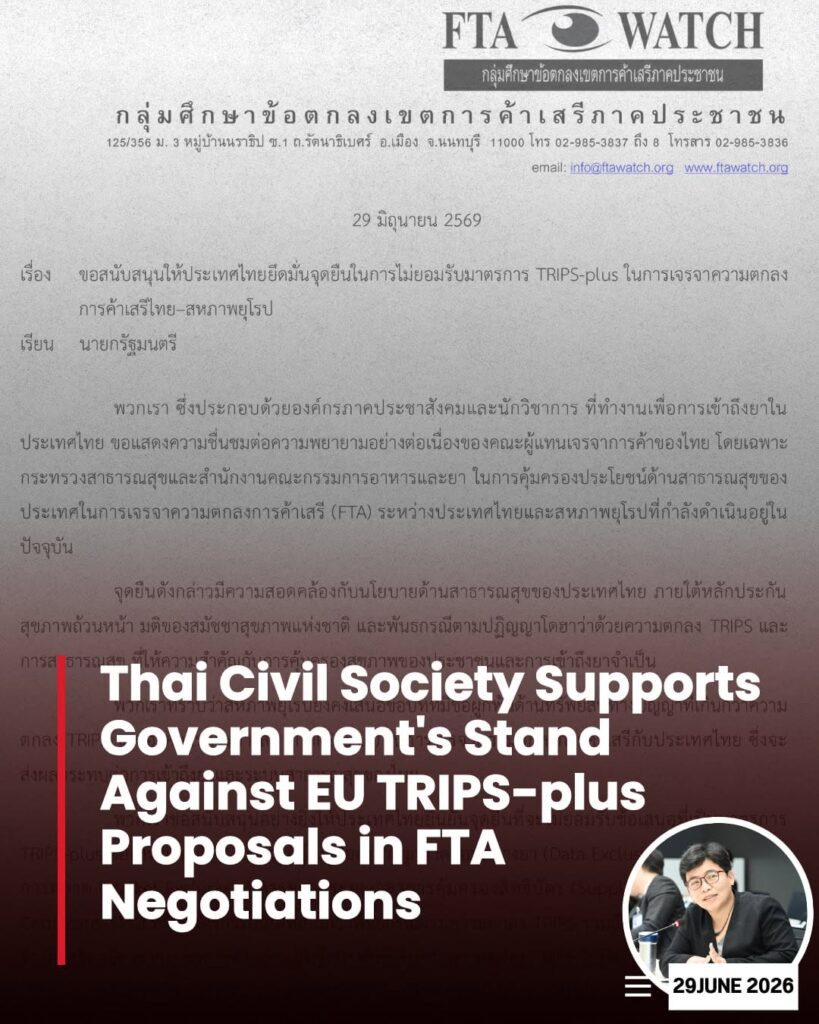
Thai civil society organisations and public health academics have expressed their strong support for the Thai Government’s longstanding position of rejecting TRIPS-plus intellectual property provisions in the Thailand–European Union Free Trade Agreement (FTA) negotiations, warning that such measures could delay access to affordable medicines, increase national pharmaceutical expenditure, and undermine Thailand’s Universal Health Coverage (UHC).
On 29 June 2026, the coalition, led by FTA Watch, the Thai Network of People Living with HIV/AIDS (TNP+), the Drug System Monitoring and Development Center (DSMD), and the Foundation for Public Health and Development (FPHD), submitted a letter to the Prime Minister and the Minister of Public Health expressing strong support for the Thai negotiating team’s efforts—particularly those of the Ministry of Public Health and the Thai Food and Drug Administration (Thai FDA)—to safeguard public health throughout the negotiations.
The coalition urged Thailand to reject all forms of pharmaceutical TRIPS-plus measures proposed by the European Union, including Data Exclusivity, Market Exclusivity, Supplementary Protection Certificates (SPCs), and other intellectual property obligations that go beyond the WTO TRIPS Agreement. The coalition said these measures are unnecessary in the Thai context and could adversely affect access to medicines, the sustainability of Universal Health Coverage, domestic pharmaceutical production, medicine security, and Thailand’s public health policy space.
The letter refers to a 2025 impact assessment jointly conducted by the Thai Food and Drug Administration, the National Health Commission Office, and academic partners. The study found that the European Union’s proposals could delay the market entry of generic medicines by at least two years and potentially by as much as eleven years, depending on the product. It also estimated that the proposals could increase Thailand’s pharmaceutical expenditure by approximately THB 130 billion over 10 years, THB 770 billion over 20 years, and THB 3.7 trillion over 30 years.
The coalition also argued that there is no justification for introducing patent term extensions to compensate for regulatory delays, noting that the Thai FDA has substantially improved the efficiency of its medicine registration process in recent years. It further stressed that Thailand already complies with the TRIPS Agreement regarding the protection of pharmaceutical regulatory data and that the EU should not use regulatory data protection as a basis for requiring measures that delay or restrict the approval of generic medicines.
Rather than introducing new monopoly rights, the organisations encouraged Thailand to improve transparency regarding pharmaceutical patent information through appropriate patent information systems while ensuring that any such mechanisms remain separate from patent linkage and do not delay the registration or approval of generic medicines.
The coalition also pointed to recent international developments, including concerns expressed by the European Parliament regarding the public health implications of TRIPS-plus provisions and continued uncertainty in the global trading environment. These developments, the coalition said, reinforce the view that Thailand should not rush to conclude the negotiations by accepting intellectual property obligations that exceed the TRIPS Agreement.

Kannikar Kijtiwatchakul, representing the signatory organisations, said:
“Trade negotiations should never come at the expense of people’s access to medicines. Thailand’s Universal Health Coverage system is internationally recognised, and the Government should continue to stand firm against TRIPS-plus measures that could delay access to affordable medicines, increase medicine costs, and weaken the country’s public health system.”