
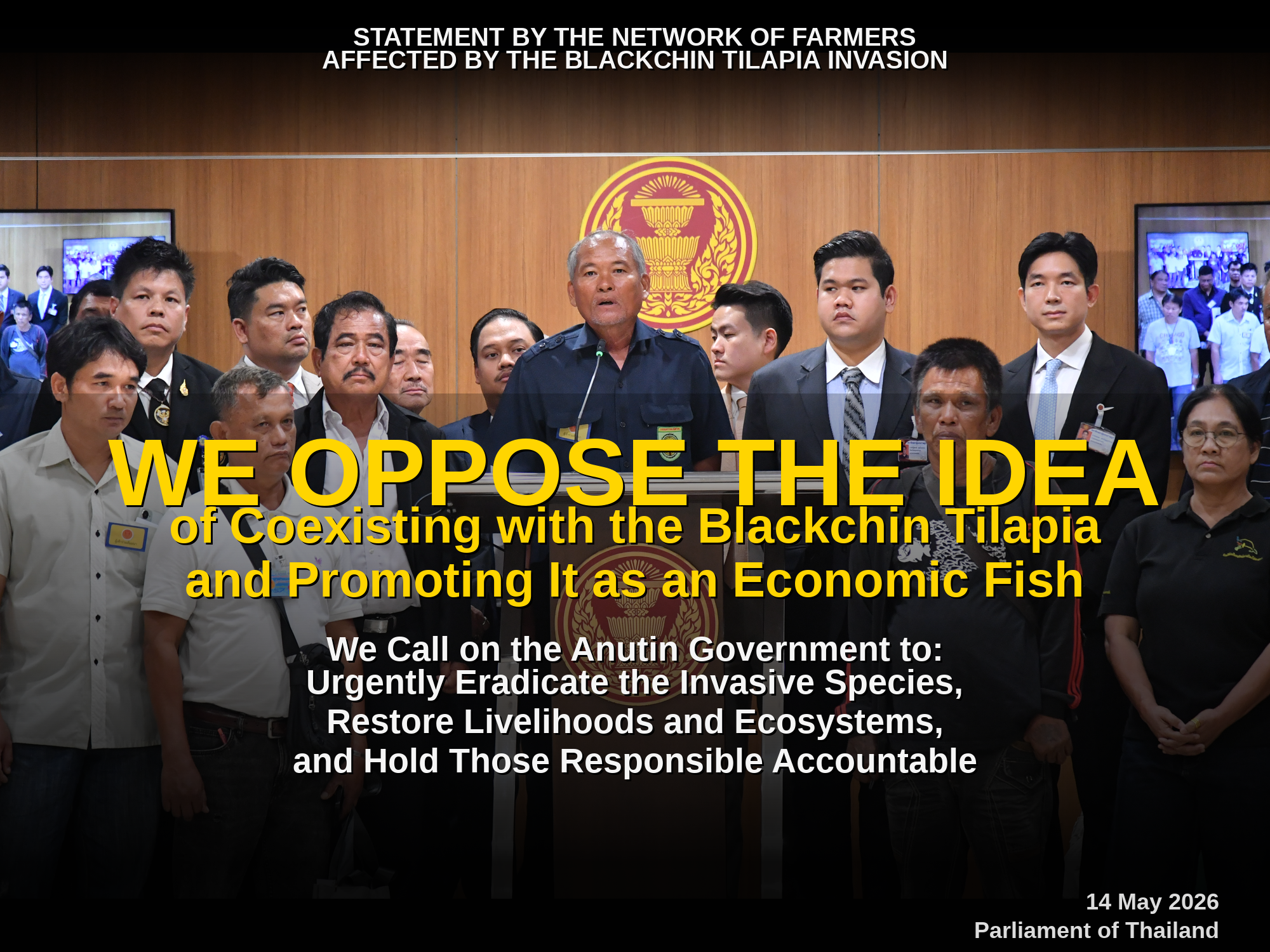
Affected farmers’ network marches on Parliament, warns that the Blackchin Tilapia outbreak remains a full-blown ecological emergency battering small-scale fishers and devastating aquatic ecosystems at every level. The network firmly rejects proposals to “coexist” with the invasive species or to rebrand it as an “economic fish,” and calls on the Anutin government to accelerate eradication, restore livelihoods and ecosystems, and hold those who triggered the disaster legally accountable.
BANGKOK, 14 May 2026 — At the Thai Parliament building today, a coalition of farmers from several provinces hit hardest by the Blackchin Tilapia (Sarotherodon melanotheron) invasion — including Bangkok, Samut Songkhram, Samut Prakan, Phetchaburi, and Chanthaburi — held a joint press conference demanding that the government of Prime Minister Anutin Charnvirakul urgently move to eradicate the invasive species and rehabilitate both the ecosystems and the livelihoods that have been gutted by more than a decade of unchecked spread.
The message was blunt: the outbreak is not over, it is not under control, and any policy that softens public perception by framing the fish as a culinary or commercial opportunity amounts to a whitewash of one of the most serious ecological catastrophes in the country’s recent history.
“The State Has Never Been Serious About Eradication”
Panya Toktong, a veteran farmer leader from Samut Songkhram who has been documenting, agitating, and organizing around the Blackchin Tilapia crisis for more than ten years, told reporters that the outbreak remains severe — both in long-affected zones and in newly invaded waters — because successive Thai governments have failed to mount a sustained, good-faith eradication campaign.
“The Blackchin Tilapia continues to multiply unchecked across the original outbreak zones — Bang Khun Thian, Samut Songkhram, Samut Sakhon, Prachuap Khiri Khan, Nakhon Si Thammarat, Songkhla, and Chanthaburi, among others,” Panya said. “And it is not only small-scale farmers who are suffering. To give a recent example, when Mr. Phanthong Chiwka drained his shrimp pond in Bang Khun Thian, he hauled out nearly 20 tonnes of Blackchin Tilapia. Even closed-system operations are not safe — earlier, a large farm in Phetchaburi found that the fish had broken into its closed culture system and devoured its entire stock of juvenile Nile tilapia. A single pond on that farm yielded 30 tonnes of Blackchin Tilapia.”
Panya warned that the geography of the crisis is widening, not contracting. “Our network now confirms the species has spread into new provinces. Blackchin Tilapia have been documented in Pathum Thani, raising real fears for shrimp and native fish populations in the rivers and natural canals of the central plains. In Songkhla Lake, residents and researchers at Thaksin University have confirmed the species’ arrival following last year’s major floods — a development that threatens to inflict massive damage on both livelihoods and the lake’s ecosystem. There are also reports that the fish has reached Penang state in Malaysia, where natural canals are now choked with Blackchin Tilapia. We are deeply concerned that the invasion will swing back into Thailand’s Andaman coast in the near future.”
“Don’t Let ‘Coexistence’ Become a Public-Relations Smokescreen”
Phanthong Chiwka, the Bang Khun Thian aquaculture farmer at the centre of the 20-tonne haul, pushed back forcefully against an emerging narrative in some official and civil-society forums that frames the Blackchin Tilapia as an opportunity to be commercialized rather than an invasive threat to be eliminated.
“I have sat in meetings where government agencies and certain organizations have spoken about ‘making use’ of the Blackchin Tilapia,” Phanthong said. “We are not rejecting that outright. But it must be made absolutely clear: catching the fish to make use of it has to serve the goal of accelerating its eradication — driving the population down, and ultimately to zero — and of restoring the ecosystem and reviving the livelihoods of aquaculture farmers. It cannot be reduced to a public-relations strategy designed to make the public forget a catastrophe that has destroyed the livelihoods of small-scale fishers and gutted aquatic biodiversity, dressed up in soothing language about ‘accepting’ and ‘coexisting’ with the Blackchin Tilapia.”
He continued: “I want to make this clear — the people of Bang Khun Thian, and our network in every other affected province, want to return to the aquaculture livelihoods we once had. We cannot, because our waters are saturated with Blackchin Tilapia. The previous government, even if its work was inconsistent, at least did something. So far, we have seen no concrete action from this government to solve the problem.”
Four Demands to the Anutin Government
Theera Wongcharoen, a farmer from Chanthaburi province and former Vice Chair of the National Farmers Council, said the network of affected farmers is formally calling on Prime Minister Anutin Charnvirakul to act on four specific demands:
1. Establish an independent commission of inquiry to investigate and identify those responsible for triggering the Blackchin Tilapia outbreak in Thailand.
2. Urgently deliver compensation to affected farmers and citizens, including by directing provincial authorities to declare disaster zones in accordance with the Ministry of Finance regulations on government emergency relief funds for disaster victims. At present, such a declaration has only been issued for the Bang Khun Thian district of Bangkok.
3. Direct the Cabinet to appoint a national committee and provincial-level working groups to eradicate the Blackchin Tilapia, restore the affected ecosystems, and rehabilitate the livelihoods of farmers and citizens, with the explicit target of reducing the Blackchin Tilapia population to zero — backed by adequate budgetary support.
4. Once the inquiry has identified those responsible, prosecute them under the law, so that the party that caused the disaster pays for the damage and the compensation, rather than allowing the burden to fall on a public budget funded by taxpayers nationwide.
“If the government continues to remain silent,” Theera warned in closing, “we will return — and the next time, we will bring several tonnes of Blackchin Tilapia with us to meet the Prime Minister and his Cabinet at Government House.”

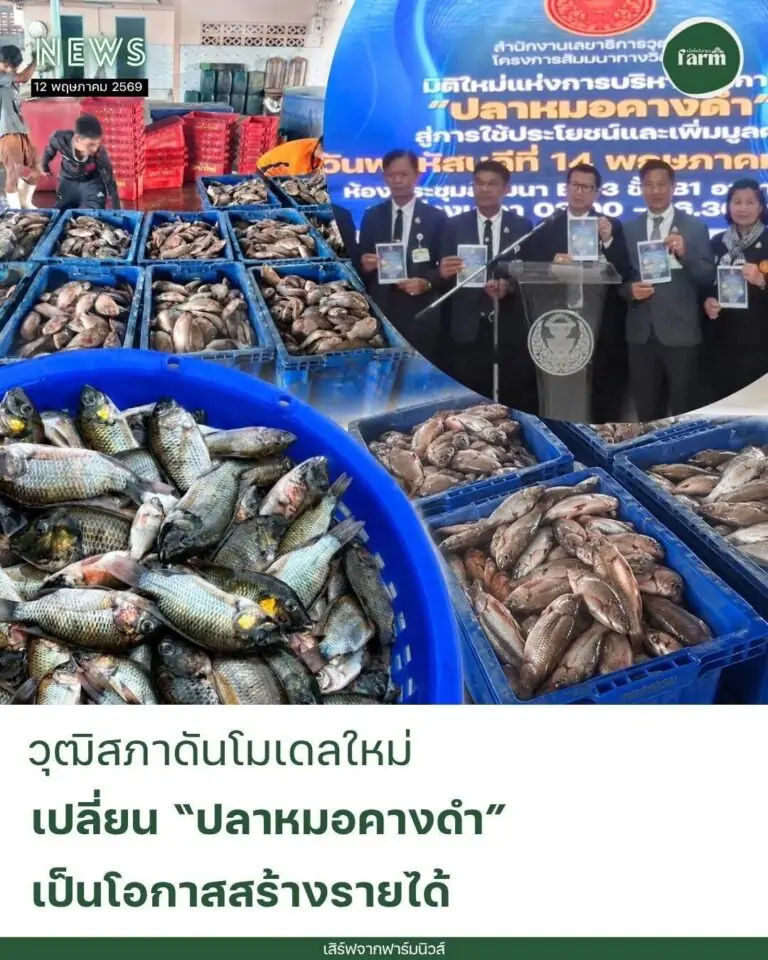
The Blackchin Tilapia (Sarotherodon melanotheron) is a West African brackish-water cichlid that has spread aggressively through Thailand’s coastal waterways, river systems, and aquaculture ponds since the mid-2010s. The species is a voracious, fast-breeding mouthbrooder capable of out-competing native fish, decimating shrimp stocks, and destabilizing entire estuarine ecosystems. Affected farmers have for years pointed to a private-sector importer as the likely source of the original release — a claim that, to date, has not been the subject of a formal independent inquiry.